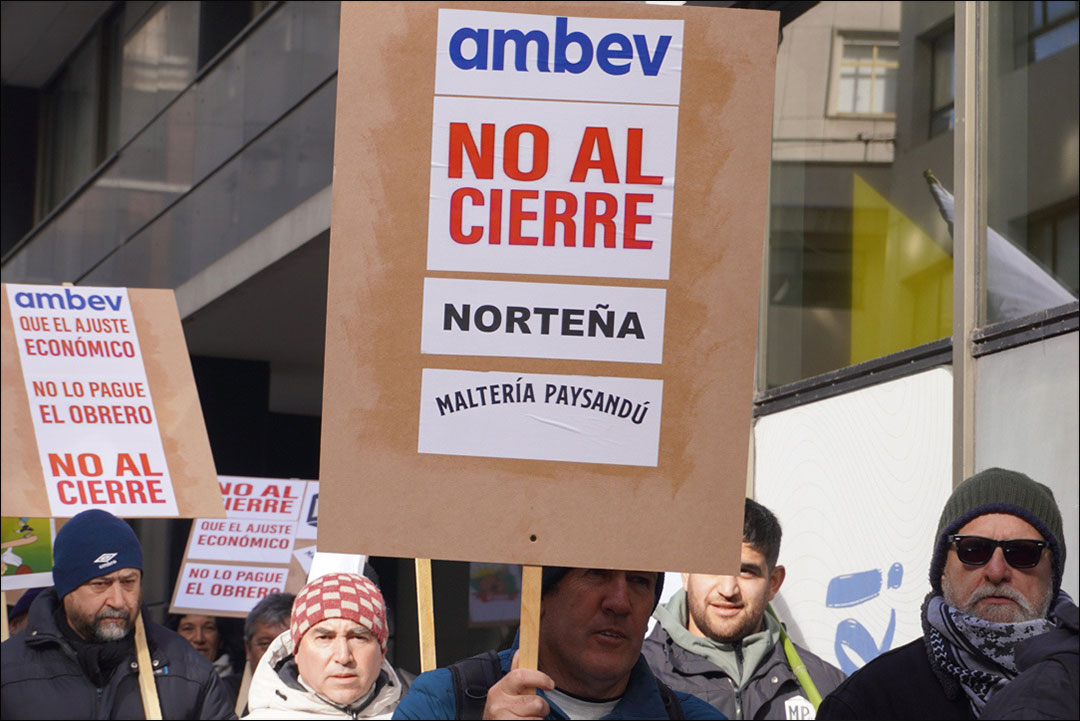
AmBev workers fighting for survival
Management at Fábricas Nacionales de Cerveza de Uruguay (FNC), a brewery owned by the multinational corporation AmBev, is playing cat-and-mouse with its workers, dangling a sword of Damocles over their heads as the fate of their jobs is decided.
Daniel Gatti
9 | 7 | 2026

In the last week of June, the company announced a temporary unemployment measure for the entire month of July affecting the 59 workers it employs at its plant in the department of Lavalleja, where the various traditional brands of beer sold in the domestic market (Pilsen, Norteña, Zillertal, and Patricia) are bottled.
The workers were due to be reinstated on July 1, but will now be in limbo for at least one more month, while the fate of the factory is decided in tripartite negotiations involving the Ministry of Labor.
Less than two years ago, the number of workers on the payroll was much larger, but they accepted downsizing without layoffs in the hope of maintaining the factory open and most of the workforce employed. That may not have been enough.
At the same time, AmBev has still not decided what it will do with its malting plan in the department of Paysandú.
The situation in that productive unit is (even) more serious than in Lavalleja.
There are 400 direct and indirect jobs on the line. The Union of Norteña Workers and Employees (SOEN), which represents the workforce, is staging various labor actions while appealing to the government to engage more fully in the negotiations.
In that plant, the temporary unemployment measure has been extended until July 31, but the order to adopt this measure comes from farther away and the company maintains a deafening silence regarding the future of the productive unit.
The workers are practically with a noose around their neck.
In conversation with La Rel, Ernesto Zelko, former labor leader with the Federation of Beverage Industry Workers (FOEB) who is advising the union in the negotiations, said local management is not even fully informed of the plans of the Brazilian parent company.
A major industrial department in the past, for years Paysandú has been witnessing the demise of many of the emblematic companies that operated across various sectors. The disappearance of the malting plant would be another heavy blow for the region.
AmBev seeks to move the barley production conducted until now in Paysandú to Brazil, with the aim of reducing costs.
“While they toy with the workers (telling them one day that they will reopen the plant and the next day that they won’t), they try to secure more benefits, more tax exemptions from the state,” Zelko highlighted.